
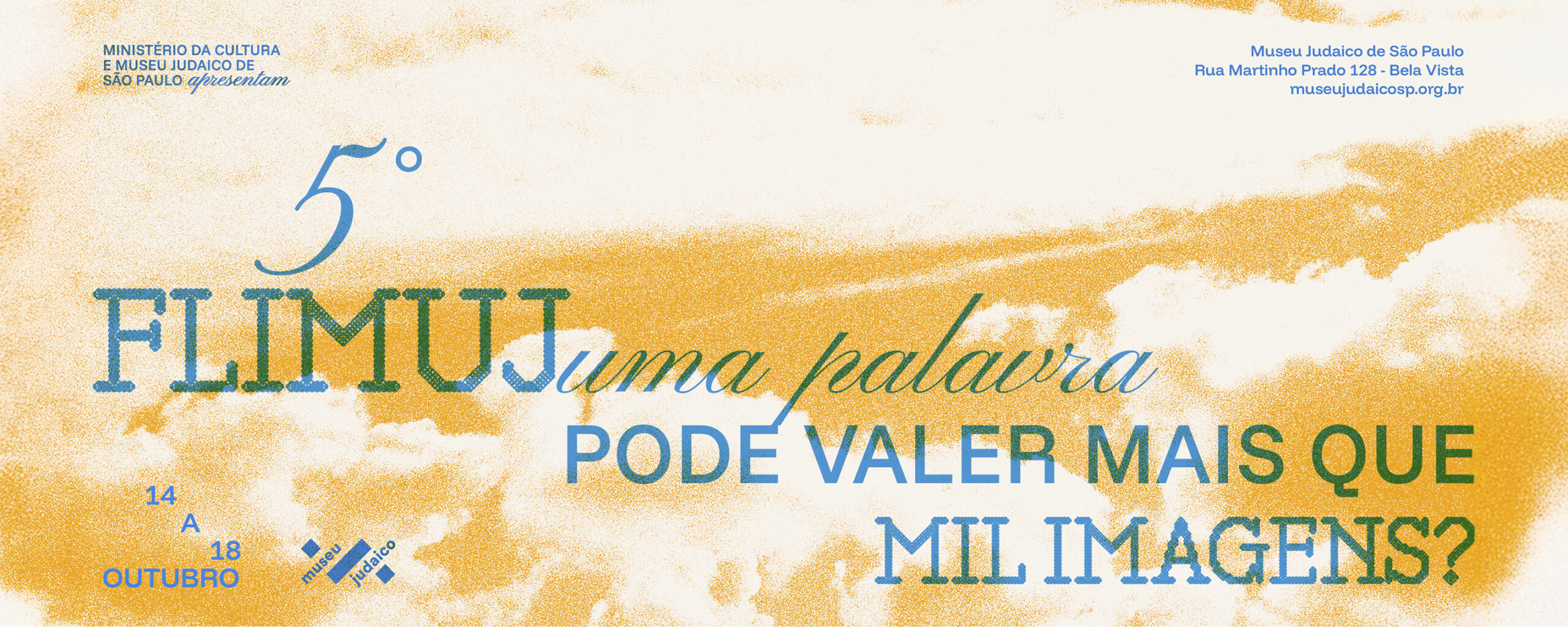
5th Literary Festival
Jewish Museum of São Paulo
Can a word be worth more than a thousand images?
The tension between word and image seems to be constitutive of the Jewish tradition.
The word holds a central place in the daily experience of many Jews. Through it, prayers and blessings are recited, teachings are passed on and memories are preserved. Moreover, speaking is not a neutral act: words create bonds, generate responsibilities and leave marks that cannot always be undone. That is why the Jewish tradition places great importance on the ethics of language. Malicious speech (lashon hara) is considered one of the gravest transgressions, seen as capable of eroding the foundations of communal life.
Images, in turn, occupy a more ambiguous place. The worship of idols is forbidden, which ended up shaping even Judaism’s sometimes reticent relationship with the visual arts. Yet images are present in realms as distinct as the illustrations of the Haggadot (the books that tell the story of Passover), the architecture of synagogues and even the design of Hebrew letters.
We also think through them. We carry mental images of people, peoples, places and cultures. And if images and words help us understand the world, they can also reduce it to stereotypes, simplifications and hasty certainties. Prejudice seems to be precisely that: an imaginary built before the encounter, a representation formulated before listening.
In an era marked by the incessant circulation of images and by the erosion of the shared languages capable of giving them meaning, the challenge lies not only in selecting what deserves our attention, but also in understanding the meanings we build from what we see. Through questions, encounters and dialogues, this is the territory that the 5th Literary Festival of the Jewish Museum of São Paulo invites the public to explore.
Jewish Museum of São Paulo
program
FliMUJ 2026 PANELS | Can a word be worth more than a thousand images?
 All panels include Libras interpretation.
Panel 1 | Oct 14, Wednesday, 7pm
Opening
How do unbelieving Jews return to Judaism?
with Sarah Hurwitz
moderated by Roberto Simon
Get your ticket
Sarah Hurwitz was a Jew estranged from religion when, on a whim, she took an introductory class on Judaism and was amazed by what she discovered: beautiful rituals, useful guidance for living an ethical life and conceptions of God that went far beyond the image of a bearded, judgmental man living in the sky. How could there be such a gap between the richness of Judaism and the way so many Jews understand and experience it? How can a millennia-old tradition, marked by reflections on ethics, community, justice and spirituality, so often be reduced to stereotypes, obligations and uninspiring childhood memories? At the opening panel of the Literary Festival of the Jewish Museum of São Paulo, American author Sarah Hurwitz, a former speechwriter for Barack Obama, Michelle Obama and Hillary Clinton, shares the discoveries that transformed her relationship with Judaism and reflects on the reasons that lead so many Jews to reject this heritage.
Sarah Hurwitz is the author of As a Jew, a New York Times bestseller and winner of the Natan Notable Book Award and the National Jewish Book Award, and of Here All Along, a finalist for two Jewish literary prizes. She was a speechwriter for Hillary Clinton in 2008 and, at the White House, for Barack and Michelle Obama from 2009 to 2017. A Harvard graduate, she also serves as a volunteer chaplain.
Roberto Simon is a journalist, writer and international analyst who has worked at financial institutions, consulting firms and think tanks in the United States. He was an international politics reporter for O Estado de S. Paulo and a columnist for Folha de S.Paulo and Americas Quarterly. He is the author of O Brasil contra a democracia and holds a master’s in public policy from the Harvard Kennedy School.
Panel 2 | Oct 15, Thursday, 3pm
What does Hebrew have to do with Yoruba?
with Rachel Reichhardt and Rodney William
moderated by Dalia Schneider
Get your ticket
Much more than mere vocabulary, languages carry stories and ways of understanding the world, creating bonds between generations. In Judaism, every letter of the Torah has a form, a meaning and strict rules of transmission, making writing a privileged space for encountering the sacred. In cultures of African origin, narratives, chants and teachings in Yoruba perpetuate ancestral knowledge and ways of relating to the divine. In this panel, soferet Rachel Reichhardt, the first Brazilian woman to write a Torah, and babalorixá, anthropologist and writer Rodney William, leader of the Candomblé house Ilê Oba Ketu Axé Omi Nlá, bring elements of Jewish and Afro-Brazilian cultures into dialogue, reflecting on the different ways communities build, interpret and keep their traditions alive.
Rachel Reichhardt is a soferet, a scribe of sacred Jewish scrolls, and the first and only woman to practice this craft in Latin America. She graduated in visual communication from FAAP, studied Hebrew at USP and Jewish education in Jerusalem. After more than 10 years of international training, she received her certificate from the Seminario Rabínico Latinoamericano Marshall T. Meyer. She took part in the Women’s Torah Project.
Rodney William Eugênio, or Pai Rodney de Oxóssi, is a babalorixá and anthropologist. He holds a PhD in social sciences from PUC-SP, is a columnist for Carta Capital and the author of works such as A bênção aos mais velhos and Apropriação cultural (translated into French). In 2019, he was named by MIPAD/UN one of the most influential people of African descent in the world. He is currently a postdoctoral researcher at the USP School of Medicine.
Dalia Schneider holds a law degree from PUC-SP and a postgraduate degree in Waldorf Education from Faculdade Rudolf Steiner. She has worked in Jewish education for almost two decades and is currently one of the coordinators of the Education Department at Comunidade Shalom – Sinagoga Masorti São Paulo. She is also a consultant to the Jewish Museum of São Paulo.
Panel 3 | Oct 15, Thursday, 5pm
Who can settle accounts with the past?
with Marcelo D’Salete and Nora Krug
moderated by Gabriela Franco
Get your ticket
Can the past be overcome? How much time does it take to work through collective traumas such as slavery and the Shoah? And what does it mean to turn the page? German author and illustrator Nora Krug was born decades after Hitler’s fall, but grew up in the shadow of a history that seemed at once present and silenced. Searching for answers about her own family’s involvement with Nazism, she delved into archives, documents and forgotten memories, turning this investigation into the book Heimat (published in English as Belonging), which addresses the relationship between guilt and identity. Brazilian comics artist Marcelo D’Salete, in turn, has devoted his career to reconstructing frequently erased stories of the Black experience in Brazil, bringing to light characters, territories and forms of resistance left on the margins of the official narrative. In this panel, two authors who move between image and word reflect on the challenges of representing traumatic pasts and discuss how memory can become an instrument of understanding, reparation and transformation.
This panel is supported by the Goethe-Institut.
Marcelo D’Salete is a comics artist, illustrator and teacher, with a master’s in visual arts. He is the author of Cumbe, Angola Janga, Mukanda Tiodora and Luanda no terreiro, among others. He has received the Brazilian Jabuti, HQMix and Grampo awards, as well as the Eisner (USA) and the Rudolph Dirks (Germany). He has taken part in exhibitions in Brazil and abroad, in countries such as Angola, Mozambique, Portugal, the United States and Spain.
Nora Krug is an author and artist whose work has been published in 21 countries. Her work combines illustration, memory and visual narrative. Her book Heimat (Belonging) received the National Book Critics Circle Award in 2018, and Diary of an Invasion was included among the Most Beautiful German Books of 2024. She holds an MFA in Illustration as Visual Essay from the School of Visual Arts and teaches at Parsons School of Design in New York.
Gabriela Franco is a journalist with 25 years of experience in culture and entertainment, at outlets such as MTV, HBO, Omelete, Folha de S.Paulo and the magazine Mundo dos Super-Heróis (an HQMIX award winner). With degrees in journalism, film and philosophy, she specialized in pop culture and comics at the Smithsonian Institution. She created MinasNerds, a portal focused on women who produce and consume pop culture.
Panel 4 | Oct 15, Thursday, 7pm
What will we do with so many years of life?
with Alexandre da Silva and Sharon Sanz Simon
moderated by Micheline Alves
Get your ticket
In a world where people live longer and longer, it has become urgent to rethink not only health, but also ways of living together, social participation and intergenerational belonging. In this panel, Alexandre da Silva, Brazil’s National Secretary for the Rights of Older Persons, and Sharon Sanz Simon, a researcher on the relationships between the brain, emotion and aging, reflect on the individual and collective impacts of longevity. Between neuroscience discoveries, demographic transformations and debates on citizenship, the guests discuss what it means to live longer and better.
Alexandre da Silva has been Brazil’s National Secretary for the Rights of Older Persons at the Ministry of Human Rights and Citizenship since 2023, and chairs the National Council for the Rights of Older Persons (CNDPI). A PhD in Public Health, physiotherapist and gerontology specialist, he has worked in care for older people for 30 years. His priority is tackling ageism and its intersections with racism, sexism, ableism and LGBTphobia.
Sharon Sanz Simon is a clinical psychologist and neuroscientist, professor at Rutgers (USA), where she directs the EngAGING lab, and researches factors for healthy aging. She holds a PhD from the USP School of Medicine, was a fellow at Harvard and did her postdoc at Columbia University. She has recently also devoted herself to science communication and fighting misinformation. In 2026 she published the book Longevidade Hoje (Fósforo).
Micheline Alves is a journalist and TV writer. She worked for twenty years in print publications and digital projects and was director of the magazines Trip and Tpm. A researcher and writer at TV Globo since 2015, she was part of the team of the show Amor e Sexo and is now a writer for the talk show Conversa com Bial.
Panel 5 | Oct 16, Friday, 3pm
What would you do today if you knew your life would end tomorrow?
with Bruna Waitman and Oscar Nakasato
moderated by Bianca Mantovani
Get your ticket
When does old age begin? When we retire? When we lose someone we love? When memory starts to fail? Or when others begin to see us only through the limitations of age? In their novels, Bruna Waitman and Oscar Nakasato present characters forced to reinvent their own lives in the face of the changes brought by aging. While Malca, on the eve of turning ninety, seeks to reaffirm her autonomy after her husband’s death, Satoshi faces compulsory retirement, his wife’s advancing Alzheimer’s and the loneliness that comes with this new moment. In this panel, the authors reflect on family relationships and the different places society reserves for older people, showing that old age is far from being merely an ending and can also be an opportunity for transformation.
Bruna Waitman is a writer. Her writing gave rise to Malca, her first novel, developed through a path of training and literary practice. She holds a degree in public administration from FGV, works in education and completed a postgraduate program in creative writing at Instituto Vera Cruz.
Oscar Nakasato is a university professor and writer. In 2010, he published his doctoral thesis on Japanese-Brazilian characters in fiction. His debut novel, Nihonjin (winner of the 2012 Jabuti Prize), was published in Mexico, Japan and Chile, and adapted into the animated feature film Eu e meu avô nihonjin. He is also the author of the novels Dois and Ojiichan.
Bianca Mantovani is a curator, researcher and cultural manager. She holds a master’s in Literature from USP, a specialization in Brazilian Studies from FESPSP and an extension course at FLACSO, Argentina. She has worked at institutions such as BMA, MCB and IMS, and curated FLIM, in São José dos Campos, from 2023 to 2025. She coordinates the cultural programming of the Jewish Museum of São Paulo and co-curates the Feira do Livro da Rocha.
Panel 6 | Oct 16, Friday, 5pm
Are there limits to a mother’s love?
with Giovana Madalosso and Hila Blum
moderated by Luara Calvi Anic
Get your ticket
How far does love go? When does care turn into overprotection? And what happens when the desire to care threatens the autonomy of those we love? In their novels, Israeli author Hila Blum and Brazilian author Giovana Madalosso present characters who try to build bonds of affection amid their own vulnerabilities. While Blum follows a mother seeking to understand the reasons for her estrangement from her daughter, Madalosso writes about a woman driven by such an intense desire for motherhood that the line between love and possession becomes increasingly blurred. In this panel, the authors reflect on the delicate boundaries between protection and freedom, showing how the deepest bonds can also be the hardest to understand.
This panel is supported by Instituto Brasil-Israel.
Giovana Madalosso is the author of A teta racional, Tudo pode ser roubado, named best novel by the Manuel de Boaventura prize, and Suíte Tóquio, published in several countries, adapted for film and nominated for the Dublin Literary Award. She also wrote Batida só and Altos e baixos. She is a columnist for Folha de S.Paulo and one of the founders of the movement Um Grande Dia para as Escritoras.
Hila Blum is a novelist and literary editor. Born and raised in Jerusalem, she is the author of the bestsellers The Visit, a finalist for the Sapir Prize in 2012, and How to Love Your Daughter, winner of the 2021 Sapir Prize and translated into several languages. A literary editor for almost three decades, she also teaches fiction writing workshops.
Luara Calvi Anic is a journalist and editor-in-chief of Gama magazine, where she co-hosts the Podcast da Semana. She holds a master’s in communication sciences from ECA-USP and, throughout her career, has worked on various titles at Editora Abril.
Panel 7 | Oct 17, Saturday, 11am
When does an image become prejudice?
with Karl Schurster and Juliano Spyer
moderated by Anita Efraim
Get your ticket
Jews make up a tiny fraction of the Brazilian population. Evangelicals, on the other hand, have grown dramatically in recent decades and now account for almost 30% of the country’s population. Despite their historical, social and demographic differences, both communities are frequently portrayed through simplifying images. After all, what makes entire and diverse groups come to be defined by stereotypes? How do certain representations shape our perception of the other? In this panel, historian Karl Schurster and anthropologist Juliano Spyer reflect on the ways Jews and Evangelicals are seen in the Brazilian imagination. Drawing on discussions about antisemitism, religion, identity and public life, the authors investigate how prejudices are built and reproduced, emphasizing the importance of seeing people and communities beyond caricatures.
Karl Schurster is a historian, professor and writer. He holds a PhD in Comparative History from UFRJ, teaches at UPE and UFPE, is a CNPq researcher and an advisor to Instituto Brasil-Israel. He studies topics such as the Holocaust and antisemitism. He is the author of books such as O antissemitismo prático and editor of Atlântico: A história de um oceano, winner of the 2014 Jabuti Prize in Human Sciences. He was a fellow at Yad Vashem.
Juliano Spyer holds a master’s and a PhD from the Department of Anthropology at University College London (UCL), where he was supervised by British anthropologist Daniel Miller. He is a columnist for Folha de S.Paulo, writing about religion, working classes, technology and society, in pieces that challenge stereotypes and reveal the complexity of contemporary phenomena.
Anita Efraim is a journalist with a master’s in Political Communication from Universidad de Chile. She contributes to Instituto Brasil-Israel, hosts the podcast “E eu com isso?” and is a football commentator on Canal GOAT.
Panel 8 | Oct 17, Saturday, 3pm
How do we find the right word to speak to a stranger?
with Bernardo Ajzenberg and Valérie Zenatti
moderated by Gabriela Longman
Get your ticket
Translating does not simply mean finding equivalent terms between different languages. It often requires understanding experiences, emotions and worldviews that seem to resist language. But what happens when we try to reach someone whose experience seems radically different from ours? In their fiction, Bernardo Ajzenberg and Valérie Zenatti follow characters who try to cross emotional, cultural, existential and political distances in search of dialogue and understanding. While Zenatti imagines an unlikely exchange of letters between an Israeli teenage girl and a young Palestinian, Ajzenberg explores characters confronted with their own anxieties, memories and desires. Writers who are also translators, both know the challenges of carrying ideas, emotions and images from one language into another. In this panel, the authors reflect on literature, translation and otherness, discussing how words can build bridges between people, cultures and experiences that at first glance seem irreconcilable.
Bernardo Ajzenberg is a writer, translator, editor, bookseller and journalist. He is the author of eleven books, such as A gaiola de Faraday, winner of the Brazilian Academy of Letters’ Fiction of the Year award in 2003, and Minha vida sem banho, winner of the 2014 Casa de las Américas prize. He has translated more than fifty works, receiving the Jabuti Prize for Purgatório, by Tomás Eloy Martínez, in 2010. He is a co-founder of the publishing house Seja Breve and of Sebo Tucambira.
Valérie Zenatti was born in France and spent her adolescence in Israel. A journalist and Hebrew teacher, she devotes herself to writing and translation, especially of the work of Aharon Appelfeld. She is the author of A Bottle in the Gaza Sea, which received several awards and has been translated in eighteen countries. She regularly takes part in activities in schools, libraries, hospitals and prisons.
Gabriela Longman is a curator, editor and journalist. She holds a master’s in Cultural History from EHESS-Paris and a PhD in Literary Theory and Comparative Literature from USP. She was a reporter for Folha de S.Paulo and has developed projects for institutions such as Sesc, Flip and Fundação Bienal de São Paulo. She is the author of Grafite. Labirintos do olhar and contributes to Folha de S.Paulo, Elle and Vogue, among other outlets.
Panel 9 | Oct 17, Saturday, 5pm
How does one become a foreigner?
with Mariano Horenstein
moderated by Julián Fuks
Get your ticket
What if the condition of being a foreigner were transformed into a particular way of seeing the world? What are we able to perceive when we stop taking as familiar what we believed we knew? In his new book, Argentine psychoanalyst Mariano Horenstein argues that true listening demands a permanent exercise of displacement and estrangement. In conversation with Julián Fuks, the book’s translator, Horenstein emphasizes the importance of encountering difference and reflects on how distinct languages, cultures and geographies transform the way we understand ourselves and others.
Mariano Horenstein is an Argentine psychoanalyst and essayist, a member of FEPAL and a former Latin American representative on the IPA Board. He was editor-in-chief of Calibán – Revista Latinoamericana de Psicoanálisis and is part of the Geographies of Psychoanalysis group. Author of O divã e a bússola and Conversa infinita, he lectures at universities and psychoanalytic and cultural institutions in the Americas, Europe and Asia.
Julián Fuks is a writer and literary critic with a PhD in Literary Theory from USP. He is the author of Procura do romance, A resistência (Resistance) and A ocupação, winner of the Jabuti, Oceanos, Saramago and Anna Seghers prizes. A columnist for UOL, his work has been translated into eleven languages and published in several countries.
FliMUJinho
FliMUJinho 2026 | What if it were me?
Programming for children on Sunday, October 18.
FliMUJinho | Oct 18, Sunday, 11am
What would you do with a fragile little creature in your room?
with Julia Rettmann and Mariana Poppovic
Get your ticket
All sorts of surprises come out of authors Julia Rettmann and Mariana Poppovic’s suitcase. Strange creatures, gross creatures, fragile creatures. What can we do to deal with them? A mirror can make us see ourselves in a whole new way. This session brings together different languages – written text, storytelling and handicrafts – to explore the ideas of self and otherness.
Julia Rettmann is an architect, but instead of houses and buildings, what she really likes to design is gardens. That is why she has worked surrounded by ferns and other plants for more than ten years. A mother who loves stories, she debuted in children’s literature with O que a gente vai fazer?, a story that began when a frog appeared inside a suitcase in an apartment in São Paulo – and continued, reinvented, in the book.
Mariana Poppovic is a visual artist, illustrator and graphic designer. She graduated in Fashion Design from Faculdade Santa Marcelina and holds a master’s in Painting from the Faculty of Fine Arts of the University of Porto. She has exhibited in Portugal and Brazil and had work published in outlets such as Folha de S.Paulo and Caros Amigos. She co-authored a children’s book and creates illustrations, visual identities and graphic design projects.
FliMUJinho | Oct 18, Sunday, 2pm
What do you do as soon as you wake up in the morning?
with Ilan Brenman
Get your ticket
What is the first thing you do when you open your eyes in the morning, after a night’s sleep? Without realizing it, some rituals mark us for life and create lasting bonds. As a boy, his mother would wake him with a glass of milk in her hands. As an adult, he was the one who took care of his mother, by then very old. Roles change over time, but some memories remain and define us. This session looks at our relationship with others through bonds of affection.
Ilan Brenman is one of today’s most important children’s authors. A psychologist with a PhD in Education from USP, he has written more than eighty books published in Brazil and translated in more than eighteen countries. His works have received major distinctions, such as the Jabuti Prize and selection for The White Ravens. Ilan also gives talks and takes part in international festivals and gatherings.
FliMUJinho | Oct 18, Sunday, 4pm
Many voices, many tones: Shall we sing together?
with Hélio Ziskind
Get your ticket
Composer, multi-instrumentalist and one of the most beloved voices in Brazilian children’s music, Hélio Ziskind has built, since the 1980s, a repertoire that marked generations on TV Cultura programs, mixing popular rhythms, humor and plenty of experimentation. If the day began by opening the suitcase of strange creatures to think together about otherness, and ended by asking whether it is possible to be friends with those who are different from us, Hélio Ziskind closes FliMUJinho in the most powerful way of all: singing together. Alone on stage, he leads a musical journey through his work, turning into song what the day’s sessions brought up for reflection: the encounter with the other as a celebration, not only as a challenge.
Hélio Ziskind is a composer, arranger, multi-instrumentalist and music producer, with a degree in Composition from USP. He co-founded the group Rumo in 1974 and became one of the greatest names in Brazilian children’s music, creating soundtracks for TV Cultura programs such as Castelo Rá-Tim-Bum and Cocoricó. Author of the hit “Hora do banho”, he won the Sharp Award with “A noite no castelo” and “Sono de gibi”.